Table of Contents
As consumer uncertainty and tariff-related costs continue to reshape the residential construction market, kitchen and bath professionals have significantly lowered their growth expectations for the remainder of 2026, according to new research from the National Kitchen & Bath Association (NKBA) and John Burns Research & Consulting.
The findings come from the organizations' 2Q26 Kitchen & Bath Market Index and 2026 Kitchen & Bath Industry Outlook: Mid-Year Update, both released July 21. Together, the reports paint a picture of an industry experiencing slower growth but showing signs of stabilization after months of economic uncertainty.
According to the reports, the overall U.S. kitchen and bath market is expected to remain essentially flat at approximately $228 billion in 2026. While higher inflation is supporting overall revenue, actual project volumes remain soft as homeowners continue to delay discretionary spending and builders navigate elevated costs.
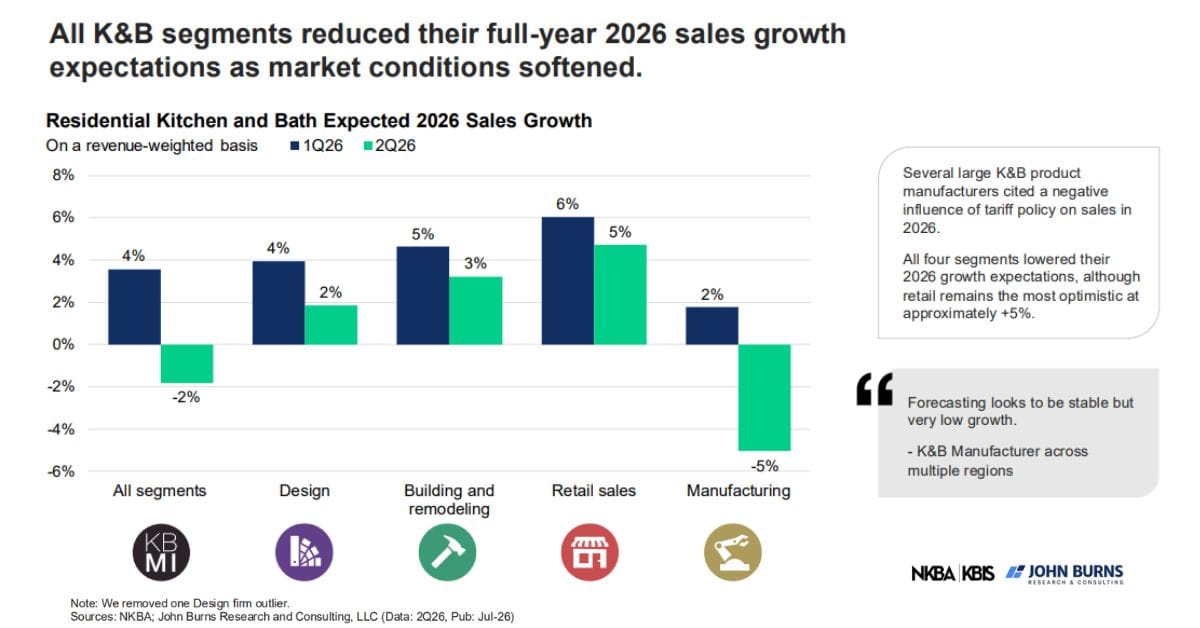
One of the most notable findings is the industry's revised outlook for annual sales growth. Compared with first-quarter expectations, all four major kitchen and bath industry segments reduced their full-year 2026 forecasts.
Manufacturing experienced the largest downward revision, moving from an expected 2 percent sales increase in the first quarter to a projected 5 percent decline in the second quarter. Overall industry expectations also shifted from 4 percent projected growth to a 2 percent decline, while design, building and remodeling, and retail all posted more conservative forecasts than earlier this year. Retail remained the most optimistic segment, with expected growth of approximately 5 percent.
The reports identify tariffs, rising material costs and continued consumer hesitation as major factors weighing on business activity. Several large kitchen and bath manufacturers surveyed cited tariff policy as having a negative influence on sales during 2026, while many firms expect trade-related pressures to continue over the next six months.
Despite those challenges, the outlook is not entirely negative.
NKBA and John Burns note that remodeling activity continues to outperform new construction, with professional remodeling remaining the strongest source of market growth. The organizations also found that firms reported their strongest second-quarter near-term sales expectations in three years, suggesting cautious optimism that market conditions could improve as the year progresses.
The quarterly Kitchen & Bath Market Index, based on responses from 500 professionals across the design, building and remodeling, retail and manufacturing sectors, remained above the 50-point threshold that indicates market expansion, although the index declined from the previous quarter as industry sentiment softened.
The complete 2Q26 Kitchen & Bath Market Index and 2026 Kitchen & Bath Industry Outlook: Mid-Year Update are available to NKBA members through the association's research portal.