

Table of Contents
Plans to potentially restart the former Domtar pulp and paper mill in Espanola are moving into a more detailed engineering phase, a development that could restore a significant outlet for wood fiber from sawmills across Northern Ontario.
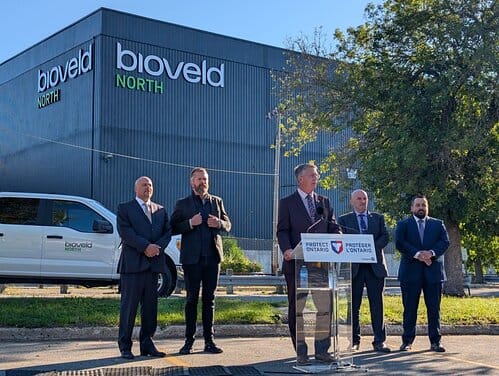
The Ontario government is providing $5.1 million through its Forest Biomass Program toward a $10.5 million front-end engineering and design program being undertaken by Bioveld North Inc., which acquired the idled mill in late 2025. Bioveld North, a subsidiary of Canadian development and investment firm The BMI Group, is contributing the remaining $5.4 million.
The engineering work will determine the design and cost of a potential restart and evaluate upgrades needed to modernize the facility. Bioveld North said it intends to restart the mill but has not yet established a timeline, with a final schedule dependent on the engineering work and additional investment.
The mill operated for more than 120 years before being idled in 2023. Its closure eliminated approximately 400 direct jobs and disrupted a forest-products supply chain that historically supported an estimated 2,000 additional jobs and 19 Ontario sawmills, according to Bioveld North.
Six of those sawmills relied on the Espanola facility for approximately 75 percent of their wood-chip sales, the company said. With the mill no longer operating, several sawmills have since been idled and much of the remaining residual fiber is being shipped outside the province.
That supply-chain connection makes the proposed restart significant beyond the pulp and paper sector. Restoring a large regional consumer of wood chips and residual fiber could provide another outlet for material generated by lumber production while strengthening the economics of sawmills supplying the broader North American wood-products industry.
Under the plan currently being studied, Espanola would return to production at approximately 800 air-dried metric tonnes per day of Northern Bleached Softwood Kraft pulp, including premium talc-free grades, along with approximately 180 tonnes per day of specialty paper for medical and food-grade applications.
The restart would represent the first phase of Bioveld North’s broader Pulp+ strategy, which envisions transforming the legacy mill into an integrated forest bioproducts complex. Future phases could add biocarbon, renewable fuels and clean power production.
“This mill was never torn down or left to rot — it was kept warm, waiting,” said Paul Veldman, CEO of The BMI Group. “Through our Pulp+ approach, we see Espanola capturing the full value of one of the richest forest regions in the country: premium pulp and specialty papers first, then biocarbon, renewable fuels and clean power.”
Bioveld North said a successful restart will require substantial private and customer investment in addition to government support. The company plans to work with mill workers, regional sawmills, the Town of Espanola and local First Nations as the engineering phase progresses.
Ontario’s funding is being provided through the Biomass Pathways Stream and Innovative Bioproduct Manufacturing and Modernization Stream of its Forest Biomass Program.
The project also comes as Canada’s forest-products industry faces pressure to find new markets and higher-value uses for domestic wood fiber and manufacturing residuals. Bioveld North said restarting Espanola could also restore domestic production of specialty pulp grades that Canada currently imports.
For wood-products manufacturers, the project illustrates the increasingly interconnected nature of the forest-products supply chain: a viable market for chips, residual fiber and other manufacturing byproducts can directly affect sawmill economics, timber utilization and ultimately the availability of raw materials throughout the downstream wood-products sector.