Table of Contents
Even with lingering economic headwinds, the kitchen, bath and remodeling sector is built to adapt — and the NKBA intends to stay “front-footed” as the industry pushes toward a gradual rebound in 2026.
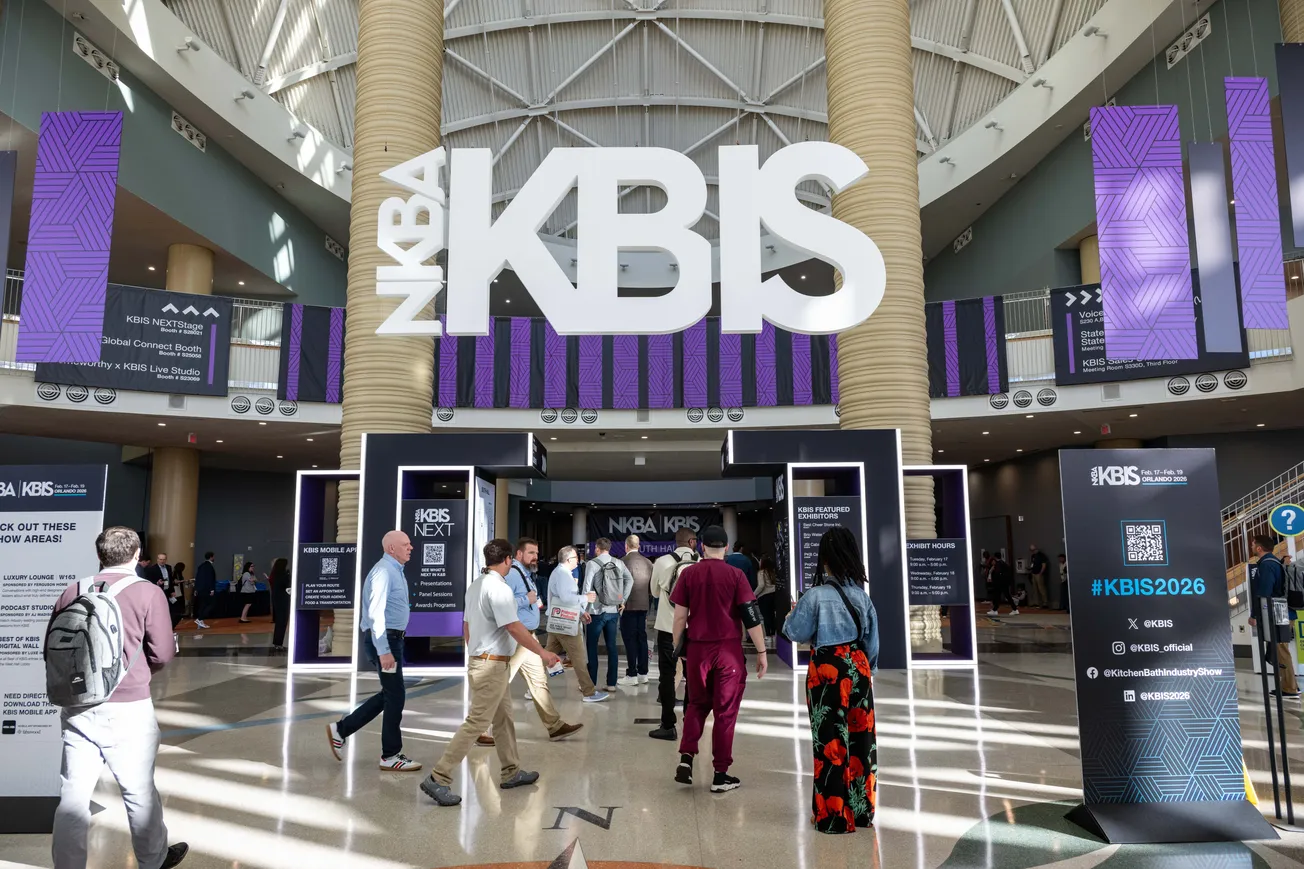
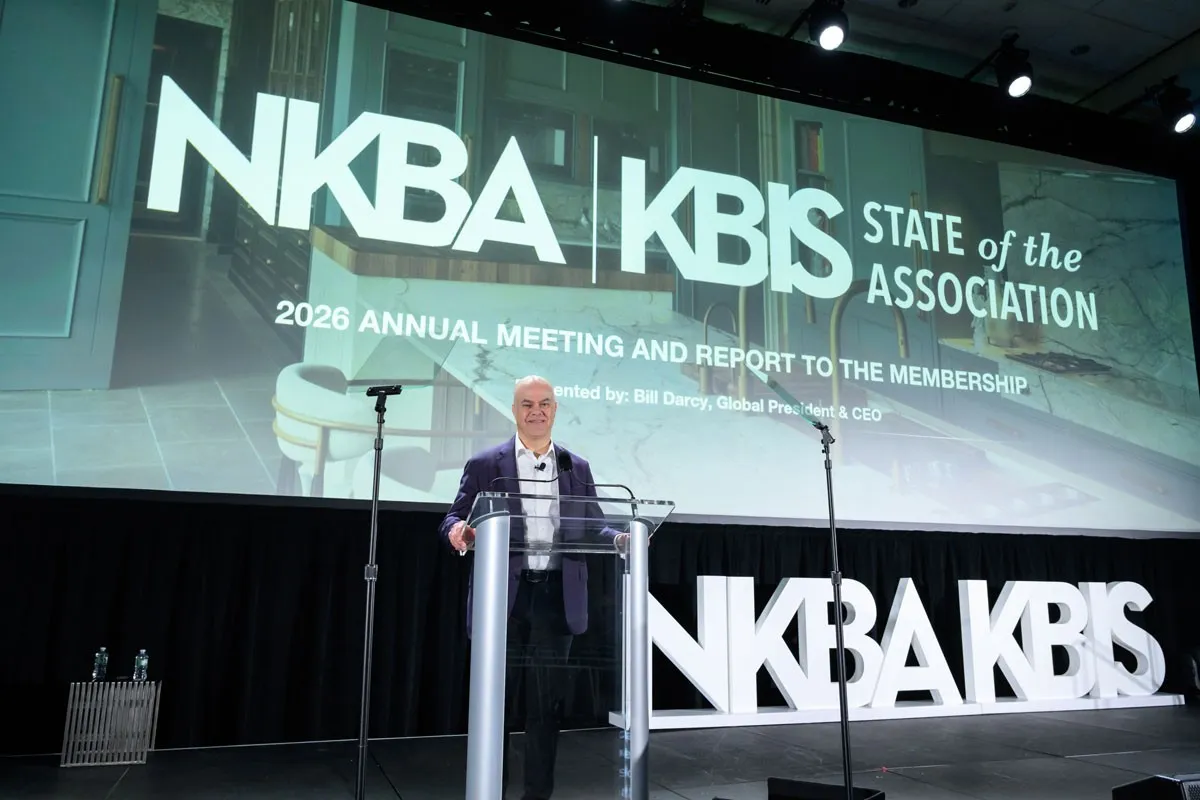
That was the message from Bill Darcy, Global President and CEO of NKBA | KBIS, during the association’s annual State of the Association address at KBIS. Darcy recapped key wins from 2025, outlined priorities for the year ahead and pointed to signs that demand fundamentals remain intact, even as uncertainty continues to influence consumer behavior.
2025: Headwinds, but resilience held
Darcy acknowledged the pressures that defined the past year: shifting tariff policies, rising material costs, an ongoing skilled labor shortage and housing supply constraints — all contributing to cautious spending.
“There’s no way to sugarcoat it,” Darcy said. “The last year was challenging for our industry. It was a period of less-than-optimal growth. That’s better than decline, for sure, but it’s not the success we know is possible.”
On tariffs, Darcy described an environment that has “upended global economic dynamics,” adding that member feedback points to slower growth and margin pressure.
But, he emphasized, the moment also underscores the value of industry advocacy.
“As we confront these challenges,” Darcy said, “it’s more important than ever for our industry to have a strong, public voice — and the NKBA is proud to be that voice.”
NKBA 2025 highlights
Darcy pointed to several momentum-building initiatives and performance markers from the past year:
- Strong financials: Since 2012, NKBA annual revenue has grown nearly 150%, reaching more than $20 million in 2025. Darcy said KBIS revenue was up 11% year-over-year in 2025.
- High Point alliance: NKBA formed a strategic alliance with the High Point Market Authority, strengthening links between kitchen and bath and broader whole-home design. NKBA also established a presence in Broad Hall at High Point Fall Market.
- Global Connect growth: The association’s international business membership program added 25 members and now represents 18 countries. NKBA also had a presence at design fairs in Germany, the UK, France and Brazil.
- Skilled labor initiatives: Darcy reiterated that workforce development remains a priority, noting chapter-led scholarships, grants, career events and continued collaboration with the Skilled Labor Fund.
Outlook: A gradual recovery led by remodeling
Looking ahead, Darcy argued that underlying conditions still support residential design and remodeling: homeowners staying put with low-rate mortgages, a large base of homes reaching prime remodeling age, and older homeowners investing in current residences rather than moving.
NKBA’s 2026 Kitchen & Bath Market Outlook, Darcy said, anticipates recovery beginning in the second half of the year, with the industry returning to growth gradually after three years of contraction. The outlook projects U.S. kitchen and bath revenue (materials + labor) rising slightly to $228 billion in 2026, with growth driven by repair/remodeling (+2.9%) and new construction expected to decline (–3%).
“The NKBA is focused on keeping our industry competitive, relevant, and thriving,” Darcy said, pointing to continued advocacy in Washington, deeper coordination with international partners, and leveraging NKBA research to help members navigate what’s next.
He closed with a call for member participation — from research and surveys to hands-on efforts to address the labor shortage — and a reminder that consumer desire for better-performing homes hasn’t gone away.
“Consumers continue to want what we can deliver: beautiful spaces and products that make their lives better,” Darcy said. “We’re smart, and we’re prepared… I’m very confident in our shared future, and you should be, too.”
State of the Industry: Jaye Anna Mize on how “home” is being recalibrated
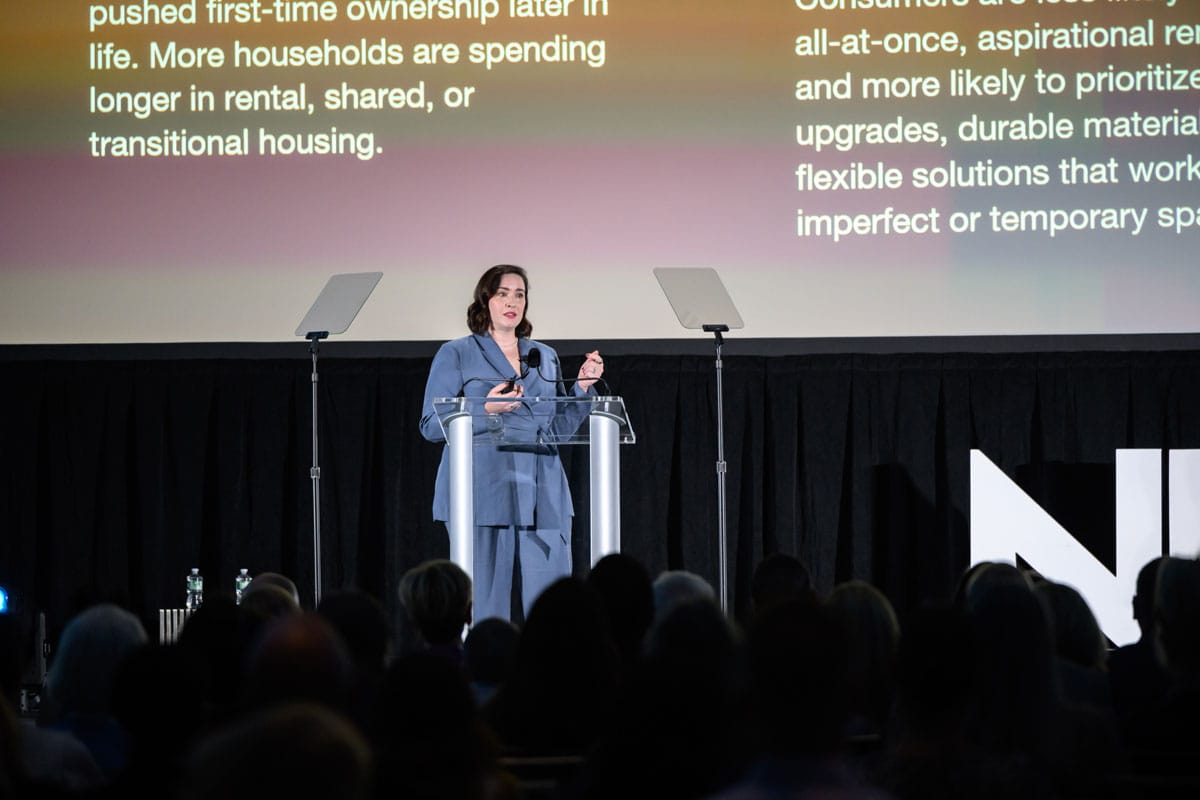
Following Darcy’s address, he introduced futurist Jaye Anna Mize, Vice President of Advisory + Partnerships at Future Snoops, for the State of the Industry presentation. Mize shared five shifts shaping consumer expectations — and what they mean for designers, brands and product strategy.
1) Beyond the “dream home”
The traditional life script — school, marriage, house, kids — carries less influence for Millennials and Gen Z, Mize said. With more debt and a heightened sense of volatility, permanence feels less certain, and housing decisions increasingly center on flexibility and near-term performance.
Instead of asking what their “dream kitchen” looks like, many consumers now ask: How do I make this kitchen work better for the next five to seven years? That shift changes what “premium” means — away from size and visual drama and toward usability, adaptability and durability.
2) Preservation over fragility
Mize described a more existential turn: luxury is moving from “refined” to “reliable.” In a world where instability is visible — economic, environmental, social — the home is increasingly viewed as protection. That shows up clearly in kitchen and bath, where materials and systems are being evaluated for how they perform and support health, safety and long-term value.
3) Streamlined shopping and AI-driven decision-making
As AI reshapes discovery, the buying journey often starts before a professional conversation begins. Clients arrive with saved boards, comparisons and shortlists already built — shifting the designer’s role from exploration to validation.
The new question isn’t “what are my options?” as much as “will this work, will this last, and will it fit the budget?” Mize said consumers still want guidance — but faster clarity and confidence, with fewer costly mistakes.
4) The kitchen as social infrastructure
Mize pointed to structural changes in new homes: fewer formal dining rooms and far more open-plan living, which concentrates daily life into shared zones. As a result, the kitchen increasingly functions as gathering space, work zone, hosting hub and emotional anchor.
Younger generations also prioritize informal, frequent connection over formal entertaining — and cooking can be communal, social and even content-driven — reinforcing the kitchen’s role as the center of gravity in the home.
5) Lifestyle living and “design alignment”
Finally, Mize argued that design now operates across a broader lifestyle ecosystem. Hotel experiences shape bathroom expectations; retail brands influence palettes; cafés inform how consumers want kitchens to feel. The home becomes less of a standalone project and more of a continuous expression of lifestyle.
“The home is no longer aspirational theater,” Mize concluded. “It is the infrastructure for modern life.” She challenged the industry to lead by designing for how people actually live now — not how we once imagined they would.